

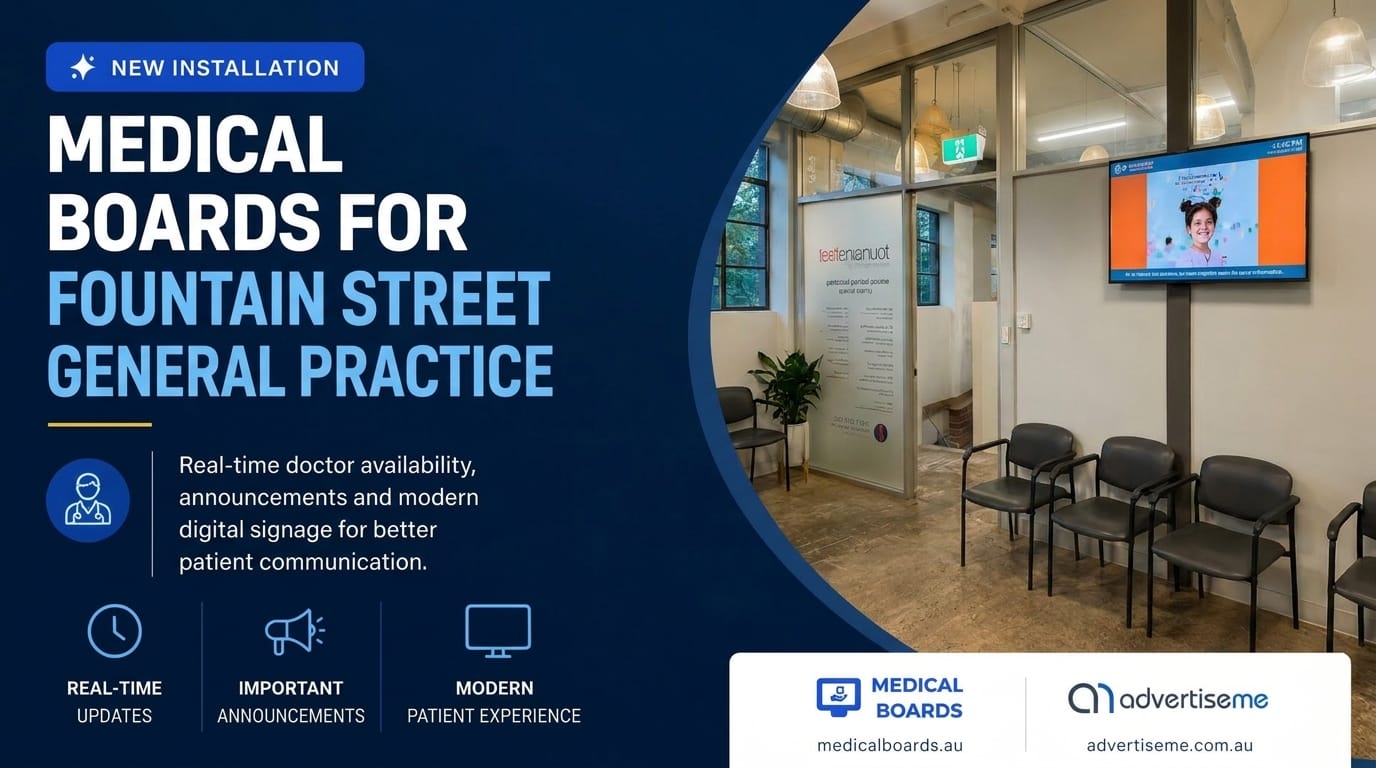
Fountain Street General Practice in Alexandria, New South Wales, has gone live with a modern digital signage solution designed to improve how information is presented across the medical centre reception and waiting room experience. This project, delivered by Advertise Me, is a practical example of how digital signage can support healthcare communication without making the environment feel complicated, crowded, or overly technical for patients and staff.
I always like seeing technology used in simple and useful ways, especially when it solves a real problem in a place where clear communication matters. A medical centre waiting room is one of those spaces where people may be watching, listening, waiting, filling in forms, or trying to understand what they need to do next, so having the right information displayed clearly on a screen can make the experience smoother for everyone. The Fountain Street General Practice project shows how a well planned medical board setup can do more than just look professional, because it can help guide patients, promote health information, reduce repeated questions at reception, and create a more organised first impression for the practice.
Looking for a digital Medical Board for your general practice?
Contact us on 1300 880 005 or request a quote and we will help you with your next digital solution.
The portfolio project can be viewed on the Advertise Me website here: Digital Signage Fountain Street General Practice Medical Board.
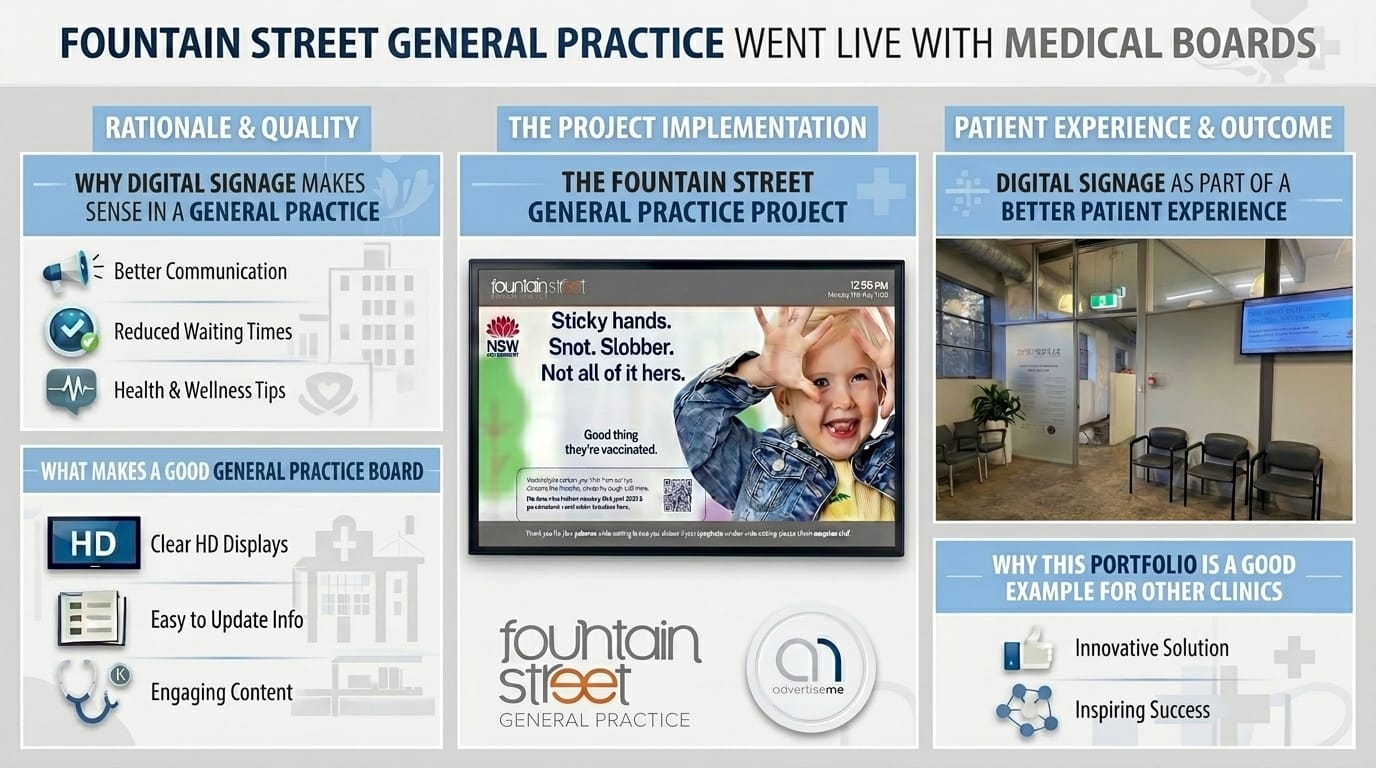
WHY DIGITAL SIGNAGE MAKES SENSE IN A MEDICAL PRACTICE
Digital signage has become one of those practical technologies that can quietly improve the way a business communicates, and in a medical practice it can be especially useful because the same screen can display welcome messages, opening hours, appointment reminders, health awareness updates, doctor availability, clinic announcements, and general patient guidance throughout the day. Instead of relying only on printed posters that may become outdated or cluttered over time, a digital screen gives the practice the ability to refresh content more easily and keep the waiting room looking cleaner and more current.
For a healthcare environment, the benefit is not just about having a screen on the wall, because the real value comes from the way the content is organised, scheduled, and presented. A good medical boards setup can help patients understand what services are available, what they should prepare before an appointment, what seasonal health topics are important, and where they can find trusted information, while the reception team can focus more on patient support rather than repeating the same instructions many times throughout the day.
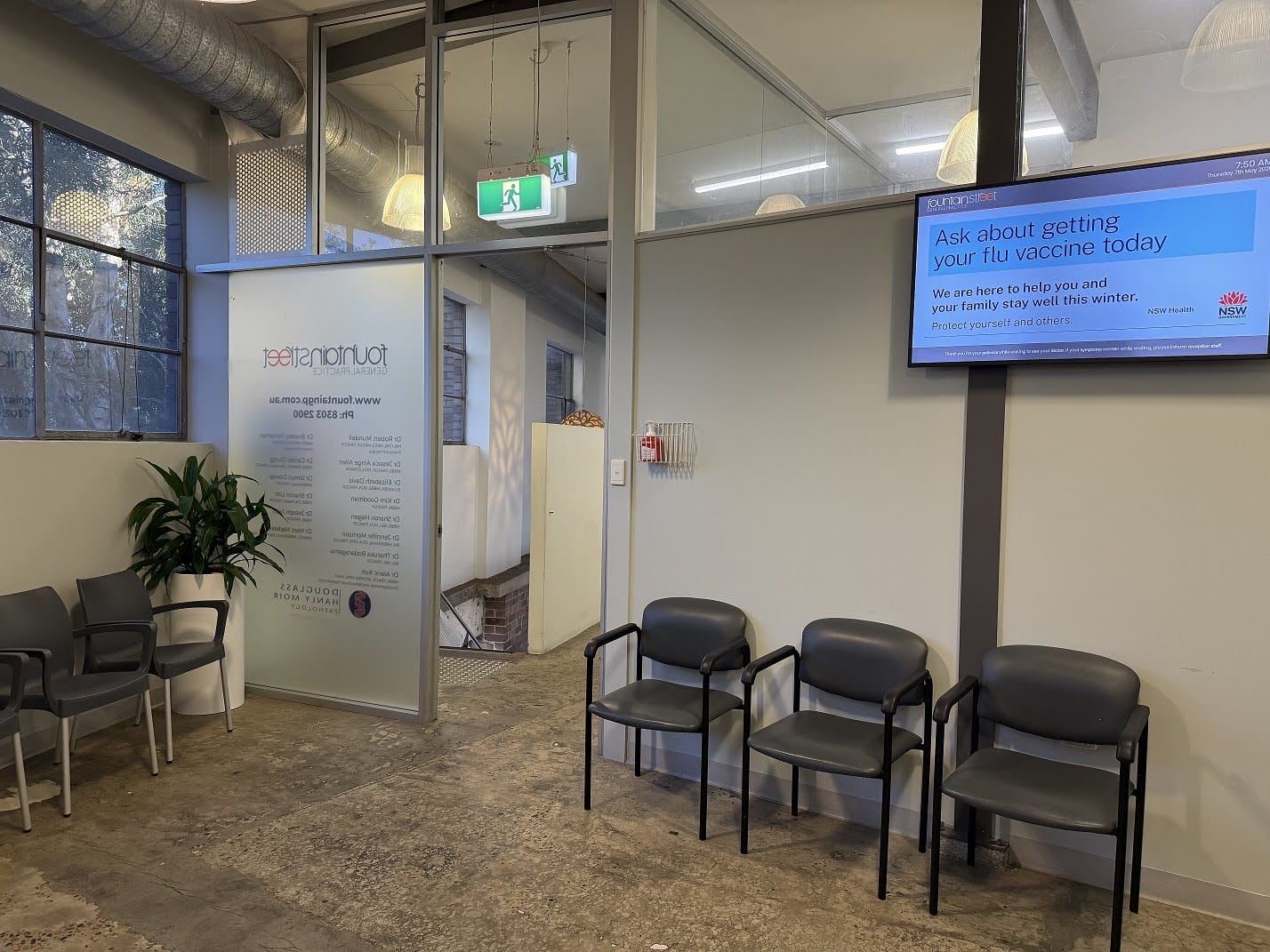
At Fountain Street General Practice, the installation appears to be part of a broader redevelopment, which makes sense because digital signage works best when it is considered as part of the whole patient journey. When a person walks into the practice, the reception desk, waiting room layout, seating, signage, lighting, and screen content all contribute to the feeling of whether the centre is organised and professional. A medical board can sit naturally within that environment and provide useful information without needing to dominate the room.
THE FOUNTAIN STREET GENERAL PRACTICE PROJECT
The Advertise Me portfolio highlights a digital signage medical board solution delivered for Fountain Street General Practice in Alexandria, and the project is a good example of how a modern screen based communication system can be used in a real healthcare setting. The aim was to support communication throughout the reception and waiting area, which is usually one of the busiest and most important areas of any medical centre. Patients arrive, check in, wait for their appointment, look for updates, and often need reassurance that they are in the right place and following the right process.
What I like about this type of project is that it is practical rather than flashy. The purpose of digital signage in a medical centre is not to overwhelm patients with moving graphics or constant promotions, because the best approach is usually calm, clear, and relevant. A well designed medical board can display important information in a professional way, using readable layouts, suitable colours, and content that matches the pace of the environment. In this case, the focus is on healthcare, medical centre communication, and general practice support, which makes the screen part of the service experience rather than just a decorative digital feature.
Advertise Me has positioned this portfolio under digital signage and medical boards, which is a strong fit because the project sits right in the middle of technology and healthcare communication. It is not just a monitor connected to a media player, because a proper solution requires planning around screen placement, visibility, content management, branding, power, connectivity, and the long term process for keeping the information updated. This is where an experienced digital signage provider becomes valuable, especially for practices that want a clean result without having to manage every technical detail internally.
 WHAT MAKES A GOOD MEDICAL BOARD
 WHAT MAKES A GOOD MEDICAL BOARD
A good medical board should be easy to read from a normal waiting room distance, and that means the layout needs to avoid tiny text, crowded slides, and too many competing messages at once. Patients may only glance at the screen for a few seconds, so the content should be structured with clear headings, simple wording, strong contrast, and enough time for people to absorb the message before the next slide appears. This sounds basic, but it is one of the most important parts of digital signage because a screen that is difficult to read quickly becomes background noise.
The best medical boards also need content that is useful for both patients and the practice. For example, a medical centre can display reminders about bringing a Medicare card, updating contact details, wearing a mask if unwell, booking follow up appointments, using online booking systems, checking pathology results, or asking reception about specific services. The same system can also support health campaigns such as skin checks, flu vaccinations, heart health, diabetes awareness, mental health support, travel medicine, and general wellness reminders, which makes the screen a flexible communication channel rather than a static sign.
Branding also matters because patients respond to environments that feel consistent and considered. If the screen content uses colours, fonts, spacing, and imagery that match the practice identity, it feels more like part of the centre and less like a random television playing disconnected content. In a medical environment, that sense of consistency can build trust because it shows attention to detail and gives the practice a more professional presence from the moment a patient arrives.
There is also an operational benefit for staff, because digital signage can reduce the need for printed notices and manual updates around the waiting room. Instead of taping paper messages to the reception window or adding more posters to the wall, the team can use the screen to communicate messages in a cleaner and more controlled way. Over time, this can help keep the reception area tidy while still allowing important information to be shared regularly.
DIGITAL SIGNAGE AS PART OF A BETTER PATIENT EXPERIENCE
When people think about technology in healthcare, they often think about booking platforms, patient records, diagnostic tools, or telehealth, but communication inside the physical practice is just as important because it shapes the patient experience in real time. A patient who understands where to wait, what to expect, and what services are available will generally feel more comfortable than someone who has to keep asking questions or guessing what comes next. Digital signage helps bridge that gap by giving the practice a clear visual channel in a space where patients are already looking around.
This is why the Fountain Street General Practice project is worth highlighting, because it shows how digital signage can be used in a grounded and service focused way. The screen is not just there to fill empty wall space, because it has a communication role that supports the practice, the reception team, and the patients. For a busy general practice, even small improvements in communication can make the day run more smoothly, especially during peak times when reception staff may be handling phone calls, arrivals, bookings, payments, and patient questions all at once.
Another useful aspect of medical boards is the ability to change messaging based on time, season, or clinic priorities. During winter, the practice may want to focus on flu vaccinations, respiratory symptoms, and appointment reminders. During summer, the focus may shift to sun safety, skin checks, hydration, and travel health. If the practice introduces a new service or changes opening hours, the screen can be updated quickly so patients receive current information without waiting for new printed materials to be designed and installed.
WHY THIS PORTFOLIO IS A GOOD EXAMPLE FOR OTHER CLINICS
For other medical centres, general practices, allied health clinics, dental practices, physiotherapy clinics, and specialist rooms, the Fountain Street General Practice portfolio is a useful reference because it shows that digital signage does not need to be complicated to be effective. The goal is to create a reliable communication system that fits into the reception environment and gives patients something useful to read while they wait. When planned properly, medical boards can become part of the everyday workflow of the practice rather than an extra piece of technology that no one knows how to use.
The most important lesson is that digital signage should be treated as a communication tool first and a screen second. The hardware matters, but the content strategy, visibility, placement, and update process matter just as much. A clinic should think about what patients ask most often, what messages staff repeat every day, what health topics are relevant to the community, and what services deserve more awareness. Once those questions are answered, the medical board can be designed to support real needs rather than simply displaying generic content.
Advertise Me has presented the Fountain Street General Practice project as a digital signage solution for healthcare, and that focus is important because medical environments require a different tone from retail, hospitality, or entertainment venues. A medical centre screen should feel calm, trustworthy, and informative, while still being visually clear enough to capture attention. It should support the patient journey, not distract from it, and it should help the practice communicate in a way that feels organised and professional.
If you are running a clinic and thinking about whether a medical board is worth considering, this project is a good reminder that the value is not only in the technology itself. The value is in better communication, cleaner presentation, easier updates, and a more modern reception experience. Patients notice when a practice feels organised, and staff benefit when routine information can be shared visually without adding more pressure to the front desk.
REAL TIME DOCTOR AVAILABILITY AND PATIENT ANNOUNCEMENTS
One of the most useful features for a general practice medical board is the ability to display real time doctor availability and patient announcements. This is the kind of information that changes during the day, so it is perfectly suited to digital signage. Instead of placing temporary notes at reception or relying on staff to repeat updates verbally, the practice can present key information on screen where patients can easily see it. Our digital signage software called AdvertiseMe.TV powered the medical boards.
Doctor availability can be shown in different ways depending on the needs of the clinic. It might list which doctors are consulting today, whether a doctor is running late, or whether certain appointment types are available. For privacy and workflow reasons, not every detail needs to be displayed, but general updates can still help patients understand what is happening. The aim is not to replace reception staff. It is to reduce repetitive questions and improve transparency.
Announcements can cover a wide range of everyday practice messages. These might include reminders to update contact details, information about booking longer appointments for complex health matters, vaccine availability, changes to pathology collection times, public holiday opening hours, or instructions for patients with respiratory symptoms. In Australia, where general practices often need to respond to seasonal demand and public health changes, being able to update these announcements quickly is very helpful.
Another useful application is directing patients through the clinic experience. A board can remind patients to check in at reception, have their Medicare card ready, silence their phone, or speak to staff if they have been waiting longer than expected. These simple messages can make the whole process feel more organised. They also support reception staff by answering common questions before they are asked.
For patient education, the board can rotate short health tips. The content should be practical and relevant, such as encouraging regular blood pressure checks, reminding patients about skin cancer awareness, explaining the importance of annual flu vaccination, or encouraging people to book preventive health assessments where appropriate. Since patients are already in a healthcare mindset while waiting, these reminders can be timely and useful.
It is also worth thinking about the tone of the messages. A good practice announcement should feel respectful and helpful. Patients do not want to be lectured while they are waiting. They want clear information that helps them understand the process or improve their health. The best signage uses plain language, avoids unnecessary complexity, and presents messages in a calm, professional style.
PRACTICAL SETUP CONSIDERATIONS
When installing medical boards, the hardware is only one part of the project. The overall setup should consider power, network access, content management, screen mounting, cable presentation, and ongoing maintenance. A clean installation matters because a medical practice should look tidy and professional. Loose cables, awkward mounting, or poorly aligned screens can make the whole setup feel unfinished, even if the display itself is good quality.
Commercial grade screens are usually preferred because they are designed for repeated daily use. In a practice environment, the board may be running for many hours each day, five or more days a week. Reliability is important because the screen becomes part of the communication system. If it turns off randomly, freezes, or becomes difficult to update, staff may lose confidence in using it. Choosing the right equipment at the start helps avoid those issues later.
The content management system should also be simple enough for the clinic team to use. A good digital signage platform allows staff to prepare content, schedule messages, and make quick updates without needing to redesign everything from scratch. Templates can be very useful because they keep the look consistent and save time. For example, the practice might have one template for doctor availability, one for health tips, one for urgent announcements, and one for general reminders.
Security and access control are also worth considering. Not everyone in the practice needs permission to edit the board. It is usually better to have a small number of approved staff who can manage the content. This helps keep the messaging accurate and consistent. Since medical practices handle sensitive information, it is important that the signage system is used only for appropriate public information and never for private patient details.
The content schedule should be reviewed regularly. A common mistake with digital signage is setting it up once and then forgetting about it. Over time, the messages can become stale, and patients stop paying attention. A simple monthly review can keep the board useful. Staff can remove old notices, add new health campaigns, refresh seasonal content, and check that everything still looks correct on the display.
Another practical detail is brightness. A screen that looks good in the morning may be too bright in the evening or affected by sunlight during certain hours. Display settings should be adjusted to suit the room. The goal is readability without glare. A comfortable waiting room does not need an overly bright screen competing for attention. It needs a clear display that patients can read naturally.
DESIGNING CONTENT THAT PATIENTS WILL ACTUALLY READ
The success of a medical board depends heavily on the content. Even the best screen will not help if the slides are cluttered, hard to read, or irrelevant. Patients in a waiting room are not sitting there to study long paragraphs. They are more likely to glance at the screen for a few seconds at a time. That means each slide needs to communicate one clear idea quickly.
A good rule is to keep text short and direct. Instead of writing a long explanation about why patients should update their details, the screen could say, “Have your phone number or address changed? Please let reception know before your appointment.” That message is simple, polite, and actionable. The same approach can be used for appointment reminders, billing information, health checks, and seasonal updates.
Visual hierarchy matters too. The heading should be large and obvious, the main message should be easy to read, and any supporting details should be secondary. If everything is the same size, nothing stands out. Strong contrast between text and background is essential, especially for older patients or anyone with vision difficulties. White backgrounds with dark text, or dark backgrounds with white text, can work well when combined with blue accents for emphasis.
Images should be used carefully. A photo of a smiling healthcare professional, a simple icon, or a clean medical themed graphic can make the slide more engaging, but the image should not overpower the message. In healthcare settings, visuals should feel authentic and respectful. Overly dramatic medical imagery can make patients uncomfortable, while generic stock photos can feel impersonal. The best content feels calm, practical, and relevant to the local practice.
Timing is another detail that can affect readability. If slides change too quickly, patients may not have enough time to read them. If they stay too long, the board can feel static and easy to ignore. A balanced rotation gives each message enough time on screen while keeping the display fresh. The exact timing depends on the amount of text and the viewing environment, but readability should always come first.
For a general practice like Fountain Street General Practice, content categories might include daily doctor information, practice notices, preventive health reminders, appointment guidance, seasonal health campaigns, and patient service information. Keeping content grouped into categories makes it easier to manage and prevents the board from becoming random. A consistent structure also helps patients know what to expect from the screen.
It can also be useful to include community relevant information. This might include local public health reminders, weather related health tips, or information about services commonly needed by the clinic’s patient base. The more relevant the content feels, the more likely patients are to pay attention. Digital signage should not just fill space. It should serve the people in the room.
THE BENEFITS FOR STAFF AND WORKFLOW
While the patient experience is a major reason to install medical boards, staff also benefit from clearer communication. Reception teams are often under pressure, particularly during peak appointment times. They answer phone calls, manage arrivals, handle billing questions, support doctors, and respond to unexpected changes. If a digital board can reduce even a small number of repeated questions, it can help the workflow feel smoother.
For example, if patients often ask whether a doctor is running late, the board can provide a general waiting update. If patients often forget to check in properly, the board can show a reminder. If the practice is running a vaccination clinic, the board can direct patients to speak with reception or follow a specific process. These small improvements can add up across the day.
Doctors and nurses can also benefit from consistent messaging. If the practice wants to encourage certain preventive health actions, the board can reinforce those messages before the consultation. A patient may see a reminder about blood pressure checks or skin checks while waiting, then bring it up during the appointment. That can support better health conversations without adding more pressure to the front desk.
From a management perspective, digital signage gives the practice a flexible communication tool. Instead of printing new posters for every update, the practice can make changes quickly and keep a cleaner physical environment. Over time, this can reduce printing waste and make the waiting area look more organised. It also helps the clinic present itself as modern and patient focused.
There is also value in consistency. When staff use the same board format for recurring messages, patients become familiar with how information is displayed. They know where to look for updates and what kind of information will appear. This makes the board part of the practice experience rather than a random screen on the wall.
A SIMPLE UPGRADE THAT CAN MAKE THE PRACTICE FEEL MORE MODERN
The Fountain Street General Practice digital signage installation is a strong example of a simple technology upgrade that can make a healthcare environment feel more modern, more organised, and more patient friendly without changing the core way the practice operates. A well placed medical board can help create a better waiting room experience, support reception staff, promote important health information, and give the practice a professional communication channel that can grow with its needs over time. For anyone interested in medical boards or digital signage for healthcare, the Advertise Me portfolio is worth reviewing because it shows the practical side of how this technology can be used in a real Australian medical centre setting.
Looking for a digital Medical Board for your general practice?
Contact us on 1300 880 005 or request a quote and we will help you with your next digital solution.


