Visitors do not come to a retail destination to get lost. They come to discover new brands, find the right store fast, and enjoy a smooth journey from arrival to checkout. For centre managers and retail marketers, that means the journey between intent and purchase needs to be as seamless as possible. Digital wayfinding is the bridge between both sides. It guides, informs, and elevates the visitor experience while giving centre teams the data and tools to optimise operations, increase dwell in the right places, and drive measurable outcomes for retailers and tenants.
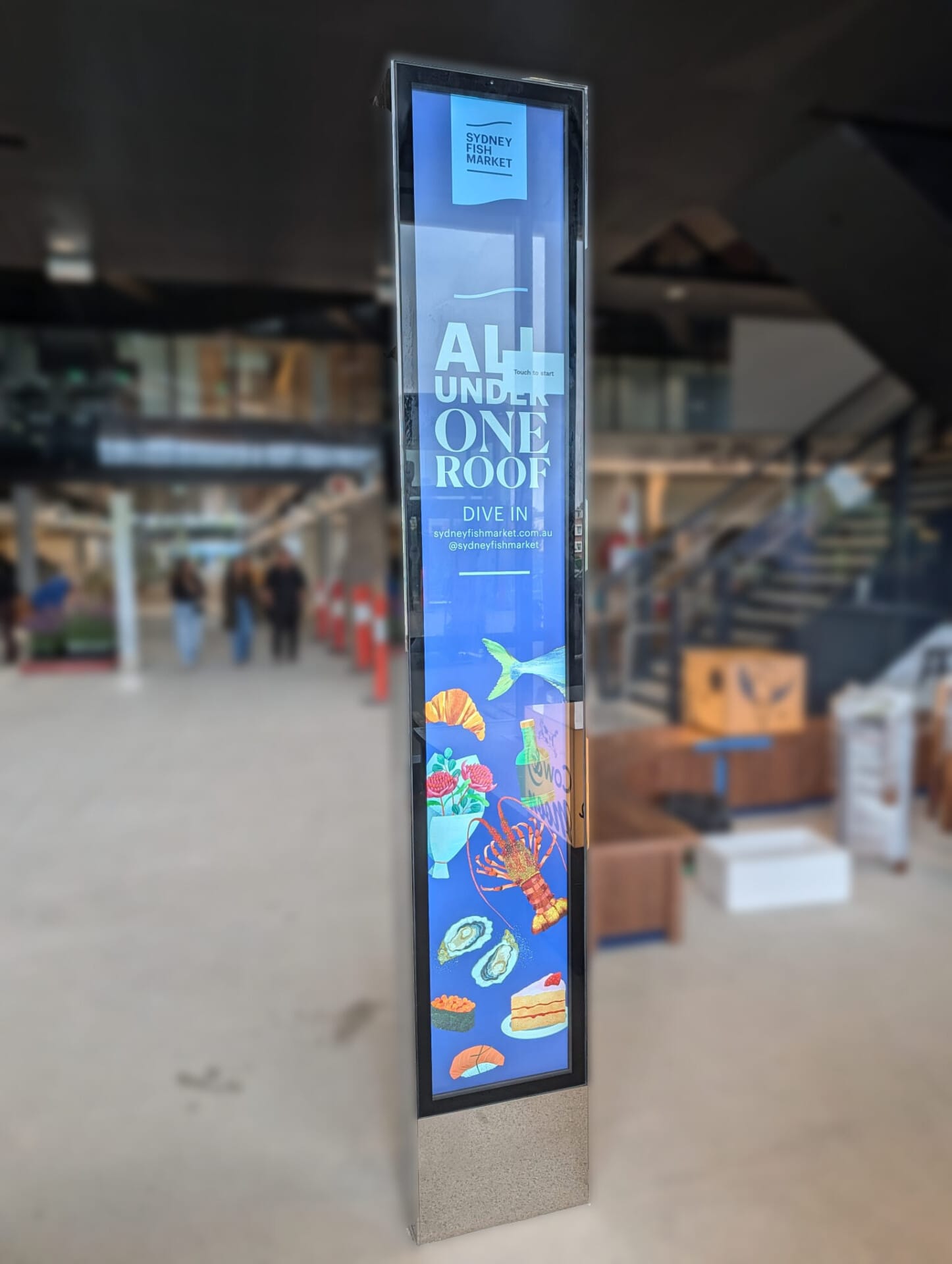
At Advertise Me, we build and deploy digital wayfinding solutions for retail environments and shopping centres across Australia. We combine robust mapping and directory software with high impact touch screen kiosks, a flexible content management platform, and a proven rollout method that puts your customers first. A standout example is the Sydney Fish Market project, where a diverse and constantly changing mix of visitors use a simple interactive directory to find seafood vendors, restaurants and facilities in one of Sydney’s most iconic destinations.
Why digital wayfinding has become the standard for contemporary retail destinations
Modern retail spaces are dynamic ecosystems. Tenants change, pop up activations shift location, event schedules update weekly, and visitor flows vary by time of day and season. Static directories struggle to keep pace with this rhythm. Digital wayfinding replaces guesswork with clear, current information and replaces fragmentation with a single system of truth. A visitor can search by name, by category, or by need, and receive a route that considers their starting point, the most direct path, and any preferred constraints such blocked routes. This is the difference between an intervention that helps occasionally and an experience that works for every person across every visit.
For retailers, that level of precision translates to more qualified footfall, greater discovery of complementary stores, and a wider reach for offers and events. For asset managers, a digital wayfinding platform adds operational agility. Teams can add new tenants and categories within minutes, highlight promotions and seasonal themes across the network, and even activate targeted messages based on time or location. The system becomes a living layer within the environment that tells the story of the precinct as it changes throughout the day and throughout the year.
There is also a powerful inclusivity dimension. Great wayfinding is not just quicker, it is fairer. It accounts for different needs and abilities with features such as large touch targets, high contrast themes, audio prompts, and clear step by step guidance. It recognises that many visitors may be international tourists or first time guests who do not know the language or the layout. Digital wayfinding lowers the barrier to entry for everyone, and that benefit is felt across the whole experience, from confidence at arrival to satisfaction at departure.
The Sydney Fish Market example, from first glance to final destination
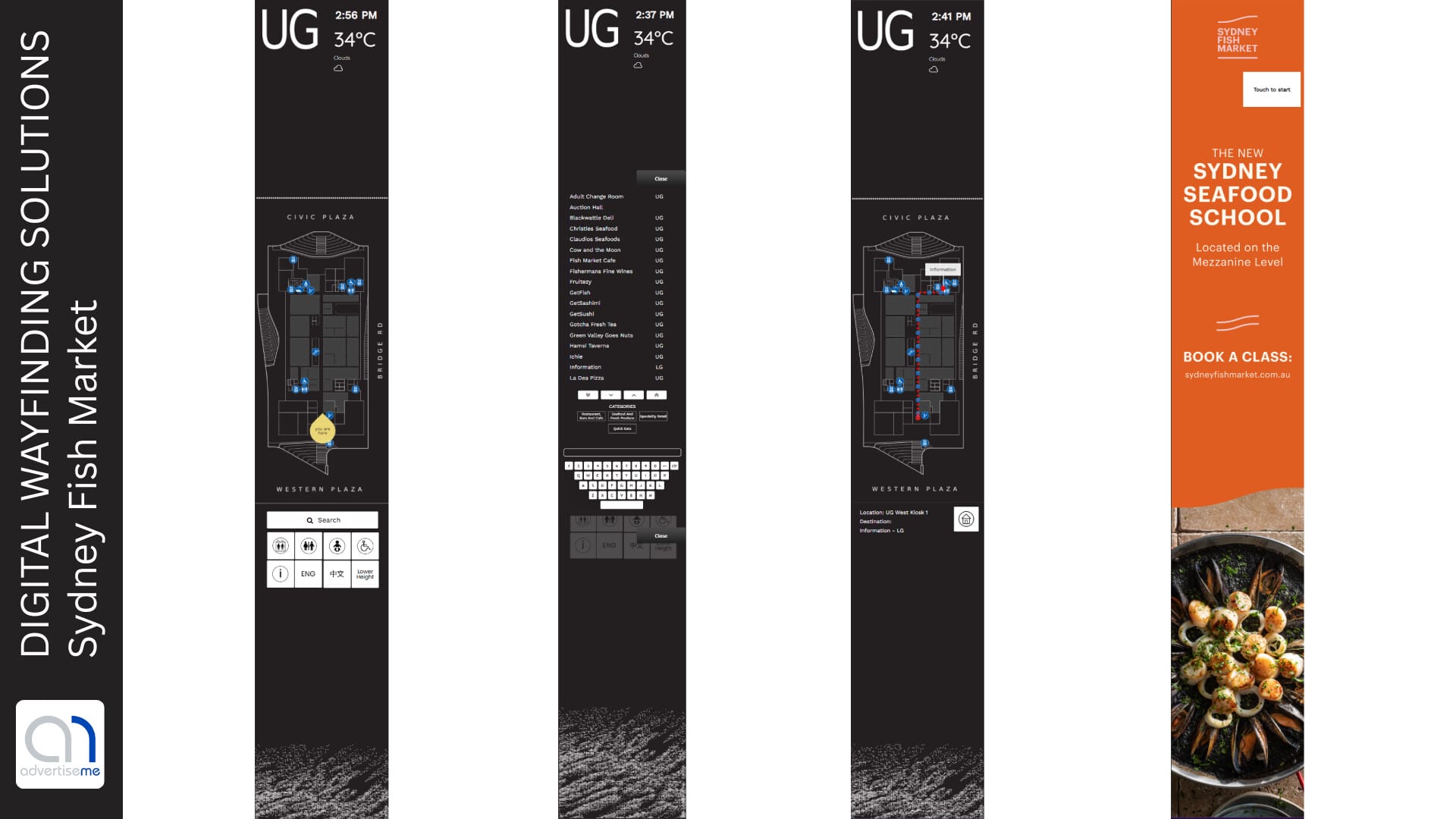
As documented in the Advertise Me portfolio, the digital wayfinding solution at the Sydney Fish Market was designed to support a destination that welcomes a diverse mix of visitors, from locals on a quick lunch run to families exploring the precinct and tourists discovering the market for the first time. The system helps people orient themselves quickly, browse by categories such as eateries and services, and navigate to specific retailers with a clear visual route. In a busy environment where the energy level is high and attention spans are short, the wayfinding interface focuses on clarity. The You are here indicator is immediate and legible, colours are used judiciously to differentiate routes and categories, and the map offers a clean overview with intuitive zoom and tap controls. The approach reflects the same product values that define Advertise Me’s broader work in retail. It makes the first interaction simple, the next step obvious, and the overall journey satisfying.
Under the surface, the Sydney Fish Market wayfinding system demonstrates how live content brings a map to life. Tenant information can be updated by authorised staff, so changes to trading hours, new service points, or temporary notices appear immediately. Categories and featured items can be adjusted to reflect the rhythm of the day and the season. When visitors look for a particular stall, the system provides a route that respects the physical reality of the space, guiding people along comfortable pathways. When the site hosts special activities, the content can draw attention to these without crowding the interface. This careful balance of live updates and restraint is central to the Advertise Me approach. The interface speaks when it needs to and stays out of the way when it does not.
Most importantly, the project shows how an intuitive digital guide can quickly become part of a venue’s identity. When visitors feel that the environment is easy to understand and easy to move through, they associate that feeling with the destination. They remember that the market was enjoyable to explore, that it was simple to find what they wanted, and that it was effortless to discover something unexpected along the way. That memory is powerful. It drives repeat visits and positive word of mouth, both of which are vital for any retail precinct or shopping centre.
Interactive navigation with the right balance of simplicity and depth
A successful wayfinding interface should reveal exactly as much as a visitor needs at a given moment. Advertise Me designs interactive maps that prioritise the most common tasks first. The search field is prominent and forgiving, with predictive input that helps visitors find results quickly even if they are unsure of exact names. Categories are presented in a way that mirrors how people think, so a visitor can tap eateries, services, or amenities, then drill into specific options. The you are here marker is prominent and the route is plotted with a clean line that avoids visual clutter. At each turn, the interface provides just enough context to support confident movement, and at the destination it gives a simple confirmation so that people can re orient for the next step.
Multi level navigation presents additional complexity. In shopping centres, a route may require a lift or stairs to move between levels. In markets and integrated precincts, the direct path may not be obvious. The Advertise Me approach handles this by breaking the route into clear stages. The screen guides the visitor to the next vertical connection, confirms the level change, and then focuses on the final stretch. Visual cues and simple language reinforce each step. People do not need a lesson in cartography to follow the guidance. They simply need a map that thinks like a well informed local. The same philosophy aids discovery. Beyond direct search, the interface can highlight popular retailers, nearby dining, and timely offers, all without asking the visitor to learn a new set of rules. It is about matching human patterns of attention and decision making.
Another key element is continuity across touchpoints. Visitors often begin with a quick glance at a directory, then continue on their own. To support this, many deployments include handoff options that let visitors take the route with them. For example, a simple on screen prompt can present a quick response code to open the route on a phone, or an easy share to a link that reproduces the guidance. This optional step respects the reality that a person might not want to return to the screen mid journey. The focus remains on a smooth path from intent to arrival.
Live updates that keep pace with real life
Nothing undermines confidence in a map faster than stale information. Digital wayfinding flips that dynamic by making the map the most current source in the environment. With Advertise Me’s content management, authorised staff can update listings, trading hours, and special notices through a simple interface. Changes cascade across the network almost instantly, so visitors always see the latest information. During busy periods, featured categories can be tuned to show breakfast options in the morning, lunch spots in the early afternoon, and family friendly highlights later in the day. When a store relocates or a new tenant opens, the system reflects the change straight away. This agility is not just convenient, it is mission critical for destinations where visitors rely on accurate guidance to manage their time.
Live updates go beyond tenant data. Integration with event calendars, transport feeds, and service alerts lets the wayfinding system communicate useful context without overwhelming the interface. A visitor who is planning to attend an event can see the best entry points and accessible facilities nearby. Guests looking for the fastest route to a station can receive step by step guidance that reflects current conditions on the site. In an emergency, the system can switch to safety messaging, pointing people to exits and assembly points in a calm, clear manner. All of this rests on a philosophy of restraint. The interface delivers timely information in a way that preserves clarity and composure.
Accessibility as a design principle, not an add on
Truly inclusive wayfinding treats accessibility as a central requirement. The Advertise Me approach embraces this from the earliest stages of design. Interfaces are tested for colour contrast and legibility, and touch targets are sized for a range of abilities. Text can be presented in larger type, and audio prompts can be enabled to read out key steps for visitors who prefer spoken guidance. Where appropriate, content can be offered in multiple languages to welcome international guests. Routes can be filtered to favour step free paths, and the interface can flag the nearest accessible facilities along the way. These considerations are not optional extras. They are essential to delivering a fair experience for everyone who walks through the doors.
In busy destinations such as the Sydney Fish Market, these features make a measurable difference. A family with a pram will appreciate clear guidance to lifts and wide routes. Older visitors will value large on screen labels and simple language. Tourists will benefit from a map that communicates meaning without requiring prior knowledge of the layout. The result is a shared environment where more people feel comfortable and capable, which enhances the overall energy and appeal of the destination.
Integration that supports smooth operations
Behind every successful digital wayfinding deployment is a content and data foundation that keeps information accurate and timely. Advertise Me designs systems that integrate with tenant databases, property management tools, and digital signage platforms, so that updates can be managed centrally and deployed consistently. If a retailer changes its name or a new amenity opens, the change can be reflected across the map, the category listings, and supporting signage in one straightforward workflow. Where required, the wayfinding system can also exchange data with parking systems, transport feeds, and event management tools, enriching the visitor experience while keeping the interface focused.
From an infrastructure perspective, stability and security are vital. Deployments are engineered for reliable performance with options for local caching to maintain essential functions during a network interruption. User data is handled with care and respect for privacy, with analytics configured to support operational insights without collecting unnecessary personal information. The goal is to provide asset managers and retailers with meaningful data such as popular queries, common routes, and usage by time of day, while maintaining a clear boundary around visitor privacy. These insights inform better decisions about tenant mix, signage placement, and service improvements, helping the destination evolve intelligently over time.
Designing for place, brand, and behaviour
Every retail destination has its own personality and logic. A digital wayfinding system should reveal both. Advertise Me’s design process begins with the essentials of legibility and simplicity, then layers in brand cues and local context. Typography, colour, and iconography are chosen to support fast comprehension, while subtle brand elements reinforce the identity of the venue. The map itself is tailored to the site, with clear landmarks, clean labels, and a hierarchy that prevents clutter. This extends to hardware selection and placement. Screens should be situated at natural decision points such as entrances, atriums, and major intersections, and positioned for comfortable viewing. Depending on the environment, enclosures may need to be robust, easy to clean, and resistant to glare. The project photographs on the Advertise Me website demonstrate how these choices translate into a cohesive presence in public space.
Critically, the interface is shaped by an understanding of how people behave in the environment. Visitor journeys are mapped to reveal where attention is high and where hesitation occurs. The interface then addresses those moments with appropriate cues. Common queries are made instant to access, while more specialised searches remain only a tap away. Language is plain and directional rather than decorative. The objective is always to get people moving with confidence, not to dazzle them with unnecessary flourish. This philosophy proved its worth at the Sydney Fish Market, where clarity and speed are at a premium during peak periods. The system meets the energy of the place with a calm, informative voice.
From planning to launch and beyond
A strong digital wayfinding solution is the product of careful planning and disciplined execution. At the outset, Advertise Me works with asset managers and marketing teams to define objectives, audit existing information, and understand visitor needs. Tenants and categories are organised into a data structure that will remain coherent as the site evolves. The physical layout is mapped with attention to decision points, vertical connections, and accessibility considerations. Prototypes are tested with real users to validate the core flows for search and route guidance. Feedback informs iteration on labels, icons, and the arrangement of information. Content governance is put in place so that updates remain consistent and the voice of the interface stays clear over time.
Deployment is staged to minimise disruption. Hardware installation proceeds alongside final content preparation, and staff receive training in the content management tools. Once the system goes live, usage is monitored to confirm that the interface is serving the most common visitor needs. Insights from early weeks help refine search priorities and highlighted content. Over time, the analytics build a picture of how the environment is used, revealing opportunities for incremental improvements to tenant mix and signposting. Support and maintenance plans ensure the system remains reliable, with remote monitoring and scheduled checks to keep hardware and software in optimal condition.
Outcomes that matter to visitors, retailers, and asset managers
For visitors, the value of digital wayfinding is immediate. It removes friction at arrival, reduces time spent searching, and fosters a sense of control. People can go straight to what they want and still feel free to extend their visit with unplanned discoveries. The main effect is a more satisfying experience that feels curated rather than confusing. This impression matters for return visits and for how people talk about the destination with friends and family.
For retailers, improved navigation increases relevant footfall. Stores become easier to discover for first time guests and for those who are open to trying something new. Featured listings and timely highlights can draw attention to new openings and seasonal offers without overwhelming the visitor. The result is a greater chance of conversion and a fairer distribution of attention across the tenant mix. Some precincts also use idle screen time to display promotions or events, turning the wayfinding network into a flexible communications channel that complements the core navigation function.
For asset managers, the system offers operational gains and strategic insight. Staff time spent answering routine directional questions is reduced, freeing teams to focus on service and safety. Updates to tenant data and notices are made once and distributed everywhere, eliminating the lag that often plagues static signage. Analytics illuminate how visitors use the space, which informs decisions on leasing, layout, and programming. This feedback loop is vital for precincts that aim to evolve continuously based on real behaviour rather than assumptions.
Why shopping centres and retail precincts should adopt digital wayfinding now
The case for adoption is both practical and strategic. On the practical side, a digital wayfinding system makes a complex environment feel simple. It cuts down on confusion and reduces the cognitive load that can otherwise dampen the mood of a visit. On the strategic side, it raises the baseline of the visitor experience in a way that aligns with the digital expectations people carry from their everyday lives. When a shopping centre provides the same clarity and convenience people expect from their favourite apps, it wins trust and attention. This is not a nice to have. It is a competitive necessity in markets where choice is plentiful and patience is limited.
There is also a sustainability dimension. Digital wayfinding reduces the need for frequent print runs of maps and directories, which are often out of date shortly after they are distributed. A digital platform ensures information is current without extra material waste. It consolidates multiple messaging needs, from navigation to event promotion, into a single, adaptable network. Over the long term, this creates savings and a more agile communications posture.
Planning your own digital wayfinding initiative with Advertise Me
If you are an asset manager, a centre manager, or a brand and communications leader at a retail precinct, the path to a successful wayfinding programme begins with clarity about your goals. Do you want to reduce congestion at busy nodes, improve the discovery of new tenants, or support a richer event programme. Do you need to accommodate specific accessibility standards or language needs. What role should the wayfinding network play in your overall communications stack. Advertise Me approaches these questions with a consultative mindset, drawing on experience across retail and public space projects. The team begins with an assessment of your site and your audience, then proposes a tailored configuration of hardware, software, and content workflows that serve your objectives without adding unnecessary complexity.
From there, the project follows a clear arc. Data collection and structuring ensure that tenant and amenity information is clean, complete, and ready to publish. Map design and interface prototyping translate the physical layout into a clear and attractive digital model. Installation and integration join the components into a working system that is tested and refined before launch. Training and handover equip your team to manage updates day to day, and support agreements provide assurance that the system will remain reliable over time. Throughout, the focus remains on delivering an experience that visitors will find easy and enjoyable, and that your operational team will find straightforward to maintain.
 The role of content and imagery in telling your story
 The role of content and imagery in telling your story
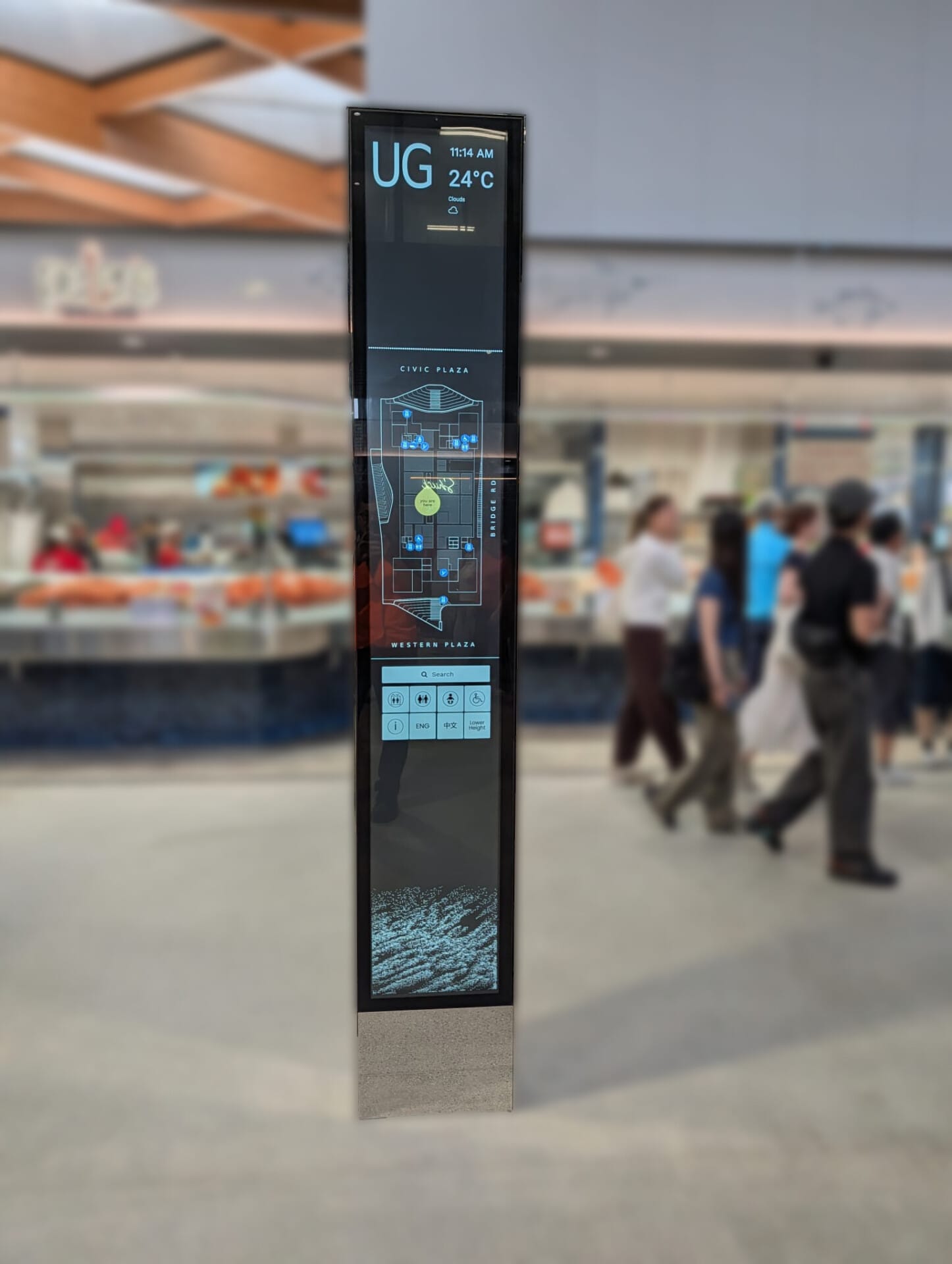
Wayfinding is first and foremost a functional tool, but it is also a powerful stage for your brand and your story. Advertise Me helps clients use imagery carefully to add context and warmth without confusing the map. Photography from your venue can help visitors build a mental model of the place they are about to explore, while subtle brand elements such as type and colour reinforce identity. In the Sydney Fish Market project, the visual language balances vibrancy with clarity, reflecting the energy of the market while keeping navigation front and centre. On the Advertise Me website, the portfolio includes images from this project that highlight how the interface sits comfortably within the architecture and the flow of people. These images are useful for stakeholders who need to envision how similar solutions will appear in their own environments.
Measuring impact and learning over time
One of the strongest advantages of a digital wayfinding system is that it creates a dataset that helps you understand how the environment is used. Common search terms reveal which categories and tenants are top of mind. Route selections can show where visitors frequently move across levels and where confusion might occur. Time based patterns can inform staff allocation, event scheduling, and promotional timing. Advertise Me provides analytics that are readable and relevant, giving managers a clear picture of how the system is serving visitors. The goal is not to gather data for its own sake, but to find the few signals that drive informed decisions. Where appropriate, qualitative feedback from staff and visitors complements the numbers, providing a richer understanding of the experience on the ground.
Looking ahead, the future of retail navigation
The future of digital wayfinding is not about novelty for its own sake. It is about refinement, responsiveness, and deeper alignment with the realities of visitor behaviour. Expect continued improvements in map design that make complex layouts feel even more approachable. Expect more seamless handoff between large format screens and personal devices, so that routes travel with visitors in a manner of their choosing. Expect smarter use of data to keep content fresh and relevant without ever feeling intrusive. Above all, expect a continued focus on accessibility and inclusion, so that every person can enjoy the environment with confidence.
In this landscape, Advertise Me brings the advantage of proven delivery, a clear design philosophy, and a commitment to service. The Sydney Fish Market project is one strong example among many, and it shows how a collaborative approach with operators and stakeholders can produce a system that becomes part of the daily life of a destination. For shopping centres and retail precincts, now is the moment to set a new baseline for the visitor experience. The technology is mature, the design patterns are well understood, and the benefits are compelling across the board.
Explore images and examples on the Advertise Me website
To see how these principles translate into the real world, visit the Advertise Me website and view the portfolio section. There you will find images from the Sydney Fish Market wayfinding project and other retail deployments. The photographs show the interface in action, with clear maps, intuitive search, and thoughtfully placed screens that complement the architecture. They also show the attention to detail in hardware selection and install quality, which is essential for long term reliability in public spaces.
Bring the same clarity to your centre or precinct
Digital wayfinding is now an essential part of the visitor experience in retail and public destinations. It reduces friction, improves discovery, and supports the operational needs of complex environments. Advertise Me delivers solutions that balance design, data, and practicality, as shown in the Sydney Fish Market project and across the wider portfolio. If you are planning a new precinct, revitalising an existing centre, or looking to improve your current signage network, now is the time to consider a tailored wayfinding system that will serve your audience for years to come.